About Good Scents

The cut flower business ended in 2011 but I continue to post other items about gardening.

Sunday, April 25, 2010

Monday April 26th, 2010

Things still running ahead. I have tons of doronicum this year (Leopard's Bane). I always say it blooms with tulips, and it does. As I've said before, the color is like a dandelion and it is just a yellow daisy, so what really makes it special is how early it blooms.

The clove scented "snowball" that is center on the pink and white bouquets is a Korean spice viburnum. This is Viburnum carlesii I believe. There are hybrids of this flower like Judd's viburnum and 'Mohawk'. The hybrids bloom earlier and grow faster but the Korean spice has the largest flowers. They all smell great to me but some people I'm sure say the Korean spice has the strongest smell.

Friday, April 23, 2010

Friday Aptil 23, 2010

Everything is really accelerated this year. The crabapples in the easement across the street are blooming and there is also a white flower blooming in the woods down the street. I think it might
be bridal wreath spirea naturalized into shady areas but I'm not sure. You can see the spirea or whatever it is in the first picture - it is the upright white flower.

There are a few bleedin hearts, too, and of course lots of tulips and daffodils. Every year most of the tulips seem to bloom within about 10 days. I will try to keep track of which are the latest ones this year and print those here.

Tuesday, April 20, 2010

The Right Amount of Weeding

I have much better luck just letting nature take its course with most difficult to germinate plants such as bleeding hearts, peonies and hellebores than I do trying to germinate them deliberately. With most of these I only want modest numbers of them anyway so that is not a problem.

Of course, there are always exceptions. I was never able to get sweet ciciely going at my house without sowing them in a seed bed over the winter and then transplanting them. I now can't get rid of the stuff and my peerless gardening partner claims it has become a weed. On the other hand, I fussed and fussed to germinate Hellebores and find they grow like weeds beneath any mature plant.

I searched everywhere for a Henry Mitchell quote about this stuff and finally found it by doing a web search. Of course, if I'd never read the whole Henry Mitchell book to begin with I wouldn't have known what to search for. I searched for "Henry Mitchell I have so many weeds", the quote is on the second page of 'A Word About Worts' in One Man's Garden:

Commonly the gardener relies on stray seedlings, but one year he wakes up to see no seedlings at all. I enjoy saying I have none at all after about the third year, and I enjoy saying this because it suggests that I weed so carefully that no little self-sown seedling has a chance. It is far otherwise. I think the trouble is I have so many weeds that no self-sown seedling has breathing space.

By this definition I must be doing about the right amount of weeding because I often get self sown seedlings and the beds are not yet overrun with weeds.

I was really shocked a few years ago to see that I was getting self sown peonies. This is through absolutely no virtue of my own - they just appeared. I thought I was quite lucky and special until I mentioned it to Patrick Lima at Larkwhistle and he said, "Yeah, they do that now and then. They're always single reds"

Oh well. I can see by their distribution that they tend to appear under certain peonies but I'm never on top of things enough in June to keep track of which peonies are creating progeny. The only exception to this rule is one peony I have planted by itself. It is at least the MOTHER of the baby peonies appearing beneath it. There are lots of self-sown alliums in the picture below (at least most of it isn't grass), and you can see several tiny peonies.


You can see that one of the babies is going to bloom this year in this picture:


The parent is a Saunders hybrid called 'Lustrous'. You can often find interesesting peonies very reasonably at Wild's. I f you're willing to poke through catalogs and wait. I paid $9 each for 'Lustrous' and 'Rushlight' in 2002. They say you can contact them with specific requests but I never got an answer when I did.

You can read something about professor Saunders and the peonies he bred here.

Monday, April 19, 2010

Monday April 19th, 2010

I actually began deliveries last week but couldn't get my act together to take pictures when I was doing all the last minute stuff (making maps for new houses etc) that I leave until the last minute every year. The flowers this week are not greatly different although the bleeding heart is new (I have a plant that is against the house - the ones in the open are not blooming yet).


The double yellow and orange daffodil is 'Tahiti', the pure white one is 'Stainless'.

The apricot and white daffocil is 'Fragrant Breeze' and the woody shrub bloom that is a pink and white cluster and smells like cloves is Judd's viburnum. I also use a later blooming variety called 'Mohican'. Both are descended from the Korean spice viburnum which is where they get their fragrance.

Monday, March 8, 2010

High and Low Tunnels

High tunnels have gotten a lot of press lately as a way that people in Michigan and other cold climates like Maine (Eliot Coleman, who has popularized their use, is a Mainer) can grow winter vegetables. I understand that people are now selling greens all winter long at the Ann Arbor Farmer’s Market and they use high tunnels to alter the climate enough to pull this off. Coleman claims using a high tunnel (basically a big, unheated, poly-covered greenhouse) is equivalent to moving 500 miles south or about one climate zone. If you use two layers of protection, for example, Remay suspended over plants inside a high tunnel, Coleman says you can gain 2 zones or about 1000 miles. In Michigan that means getting to Zone 7 or Tennessee and parts of Georgia.

This past fall I created some low-tunnels, kind of the poor man's version of a high tunnel. I used 18” pieces of rebar set 4’ apart and placed an 8’ piece of PVC pipe over each section of rebar. I then used cheapo 4mil clear plastic from Lowes to keep out the weather. Each piece of PVC protected about 3’ of ground, and I used 4 pieces, so a total of about 12 feet ended up covered. At either end, I cut the plastic kind of long, twisted it into a big, 4” rope and covered it with something heavy like a cement block or big piece of junk cement.

Sometime in the fall – I guess it was around early September – I started planting spinach every couple weeks. I covered the soil with the plastic starting in late October November and kept planting spinach until around that time. The smallest plants only had one pair or true leaves in the fall.


I had lots of spinach to harvest for Thanksgiving and then pretty much covered the bed and forgot about it over the winter. This WAS a fairly mild Michigan winter - I don't think it ever went below 0F. The pictures I just took show how well spinach can grow in cold weather. The other picture is of mache that I grew in big coldframes.
The thing I like about low tunnels is that they can be about any size you like and anyone can go to Lowe's or Home Depot and buy everything they need to throw one together. You don't need a big yard or a store bought high tunnrl to begin growing greens (and I guess other stuff) out of season.

Thursday, November 12, 2009

Clean up and November Flowers

My last delivery was on October 16th and since then I've put in 2300 tulips for next year and finished cleaning up all the beds at the farm. For beds containing perennials, this means cutting everything down and removing as many weeds as I can manage. For the beds that contained annuals, the plants pulled out, the bed weeded and tilled, about 5-7 wheelbarrows of compost are added, and then the bed is tilled again. Then the bed is covered with straw to prevent germination of weeds until next year. I prepped about 50 4'x25' in this fashion, moving about 25 yards of compost by hand. The best thing about doing this is that I get to eat all the ice cream and peanut butter I want and don't gain any weight.

On my last trip to the farm I cut a final bouquet. It is a bit dull because it is all blues and purples but pretty cool to be able to still harvest flowers in November.
The flowers are delphiniums, asters and sea hollies.

Monday, August 31, 2009

Bouquets for Monday August 31st, 2009

I have lots of different flowers to work with right now so I'm able to make more different color combinations. Herre are 5 different ones though there were probably 10 different color combinations today.
I used only dark red and dark purple in this first one. This might not be what you'd want if you were depressed but one of my daytime customers said, "Wow! I like that" when I handed it to her. The dark purple flowers are lisianthus, the small red ones are 'Serenade' china asters and the large red ones are zinnias. A single dark red snapdragon spike adds an another variety to the shapes.


This birght bouquet of orange and white might be exactly what you'd want if you were feeling depressed. The large orange flowers are zinnias and the small orange ones are butterfly weed. The whites are lisianthus and a large white dahlia, and the greenery is artemesia.


This yellow and white that is also very cheery. A yellow snapdragon is surrounded by yellow lilies, white lisianthus, goldenrod (not yet open), and yellow zinnias.


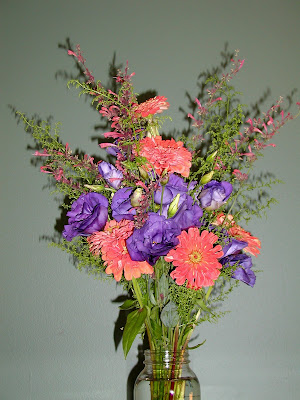
I always like using complementary colors. Here purple lisianthus are paired with salmon zinnias and agastache.


Fall is definitely coming in this last bouquet of yellow and rusty oranges. The small daisies are helenium, combined with sunflowers, zinnias and dahlias. The cattail spikes are an ornamental millet called 'Purple Majesty'.